
This Visual Studio Code plugin provides an interface to Composer dependency manager for PHP.It also provides schema validation for composer.json configuration files.
- Visual Studio Code Cmd.exe
- Visual Studio Code Cmd Terminal
- Visual Studio Code Vs Microsoft Visual Studio
- Visual Studio Code Cmd Command
- Visual Studio Code Cmd Terminal
- Visual Studio Code Command Line Mac
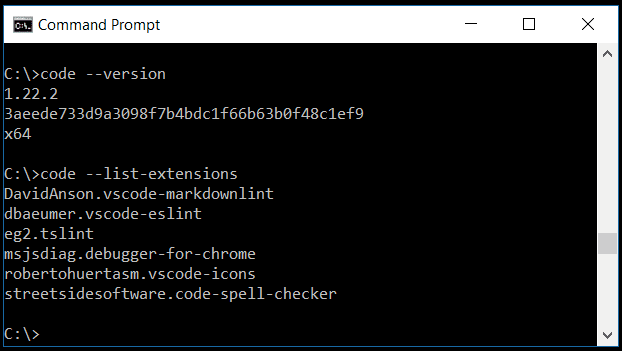
Open a WSL project in Visual Studio Code From the command-line. To open a project from your WSL distribution, open the distribution's command line and enter: code. You can also access more VS Code Remote options by using the shortcut: CTRL+SHIFT+P in VS Code to bring up the command palette. With rustup missing, you won’t be able to get the Rust Language Server (RLS) up and running in Visual Studio Code. When you click on the button, your browser will download the rustup-init.exe executable, which is essentially a command-line installer. Proceed along with the.
Installation
You must install Visual Studio Code and Composer on your system before you can use this plugin.
Visual Studio Code Installation
If Visual Studio Code is not installed, please follow the instructions here.
Composer Installation
If Composer is not installed, please follow the instructions here.
Plugin Installation
- Open Visual Studio Code.
- Press
Ctrl+Pon Windows orCmd+Pon Mac to open the Quick Open dialog. - Type
ext install composerto find the extension. - Press Enter or click the cloud icon to install it.
- Restart Visual Studio Code when prompted.
- Go to Visual Studio Code user settings and configure the composer.executablePath setting.
Configuration
You can configure the following options by making changes to your user or workspace preferences.
composer.enabled
[ Scope: Global | Optional | Default: true ]
Visual Studio Code Cmd.exe
Use this setting to enable or disable this plugin.
composer.executablePath
[ Scope: Global | Required ]
Use this setting to specify the absolute path to the composer executable on your system.
Example user settings.json on Mac/Linux:
Example user settings.json on Windows:

Important: You will be unable to use this plugin unless you configure this setting before first use.
composer.workingPath
[ Scope: Workspace | Optional | Default: null ]
Use this setting to specify the absolute or workspace relative path to your composer.json. If not specified the workspace root path is used as default.
Example user settings.json on Mac/Linux:
Example user settings.json on Windows:
Usage
All composer commands are available through the Command Pallet using F1.
Supported Commands
Composer: About
Display short information about composer.
Composer: Archive
Create an archive of this composer package.
Composer: Clear Cache

Clears composer's internal package cache.
Composer: Diagnose
Diagnoses the system to identify common errors.
Composer: Dump Autoloader
Dumps the autoloader.
Composer: Install
Installs the project dependencies from the composer.lock file if present, or falls back on the composer.json.
Composer: Remove
Removes a package from the require or require-dev.
Composer: Require
Adds required packages to your composer.json and installs them.

Composer: Run Script
Run the scripts defined in composer.json.
Composer: Self Update
Updates composer.phar to the latest version.
Composer: Show
Show information about packages.
Composer: Status
Show a list of locally modified packages.
Composer: Update
Updates your dependencies to the latest version according to composer.json, and updates the composer.lock file.
Visual Studio Code Cmd Terminal
Composer: Validate
Visual Studio Code Vs Microsoft Visual Studio
Validates a composer.json and composer.lock
Composer: Version
Visual Studio Code Cmd Command
Shows the composer version.
Contributing and Licensing
Visual Studio Code Cmd Terminal
The project is hosted on GitHub where you can report issues, forkthe project and submit pull requests.
Visual Studio Code Command Line Mac
The project is available under MIT license, which allows modification andredistribution for both commercial and non-commercial purposes.